
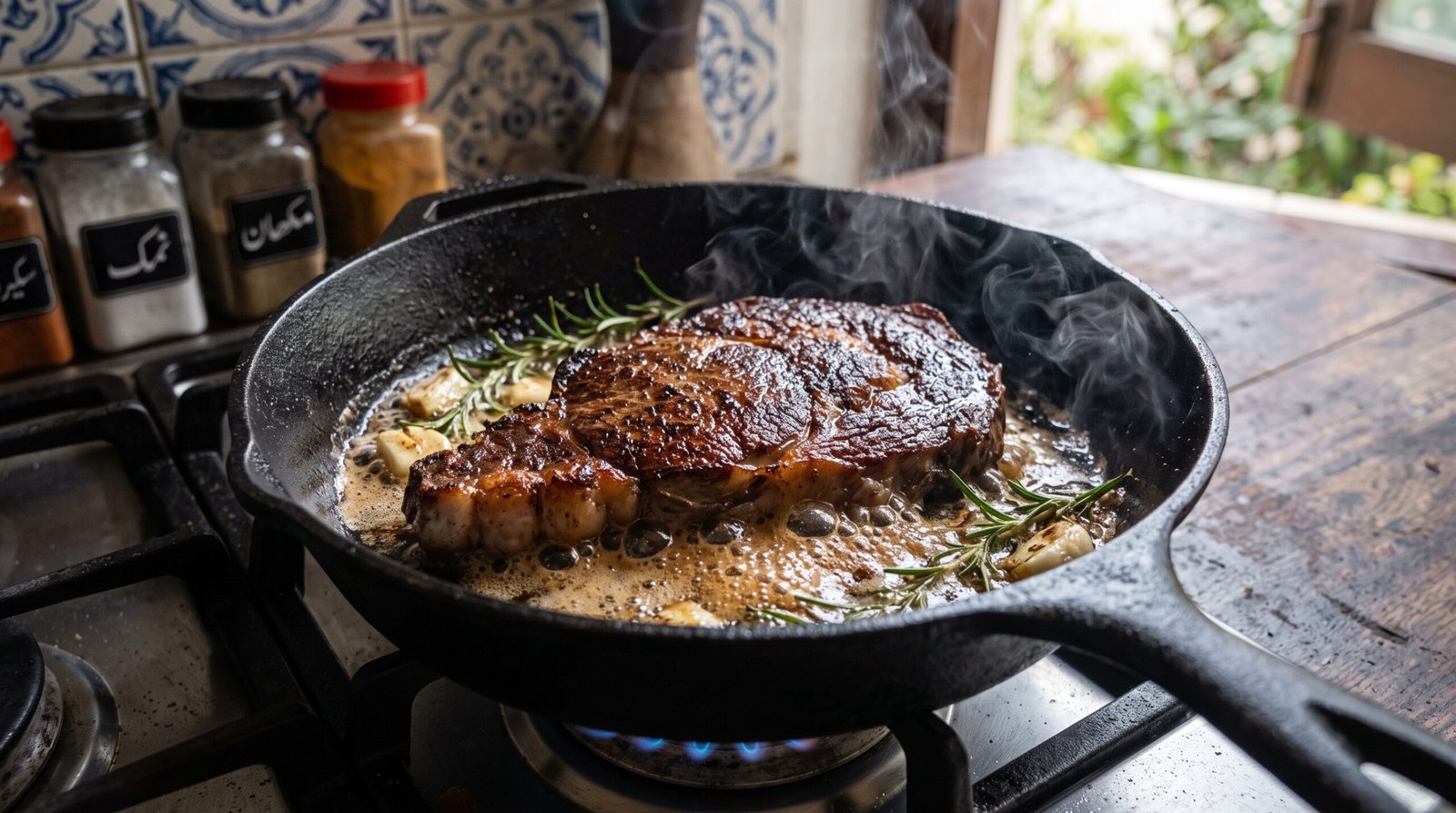
Searing & Heat Control: How to Get a Restaurant-Quality Crust on Steak at Home
Achieving that deep, golden-brown caramelized sear at a high-end steakhouse often feels impossible to replicate in a home kitchen. Many home cooks end up with a gray, steamed surface or an overcooked interior long before a deep crust forms. Mastering how to get a restaurant quality crust on steak comes down to basic food science, thermal management, and removing moisture before the meat ever touches the pan.
By controlling surface humidity, leveraging high thermal mass cookware, and maximizing the Maillard reaction, you can achieve a steakhouse-worthy sear on any thick-cut steak right on your stovetop.
Key Takeaways
- Moisture Kills the Sear: Water boils at $212^\circ\text{F}$ ($100^\circ\text{C}$), while the Maillard reaction requires temperatures above $300^\circ\text{F}$ ($150^\circ\text{C}$). The surface of the steak must be completely dry.
- Dry Brining Is Essential: Salting your steak 12 to 24 hours in advance uncovers hidden moisture, draws it out, and dries the surface layer.
- Heavy Cast Iron Wins: Use high thermal-mass pans like cast iron or carbon steel that retain intense heat when cold meat hits the surface.
- Baste with High-Fat Butter: Butter basting (arrosé) fills micro-crevices on the steak’s surface, accelerating browning and delivering a rich, savory finish.
The Science of Searing: The Maillard Reaction
The secret behind a crispy, flavorful crust is the Maillard reaction—a chemical reaction between amino acids and reducing sugars that occurs when food is exposed to heat above $300^\circ\text{F}$ ($150^\circ\text{C}$).
If your steak has excess surface moisture, that water turns into steam. Steam caps the pan temperature at $212^\circ\text{F}$ ($100^\circ\text{C}$), effectively boiling the outside of your steak rather than searing it. Removing surface water is the single most important step to achieving a restaurant quality crust on steak.
Step 1: Prep & The Power of Dry Brining
To eliminate moisture, prepare your meat hours before cooking.
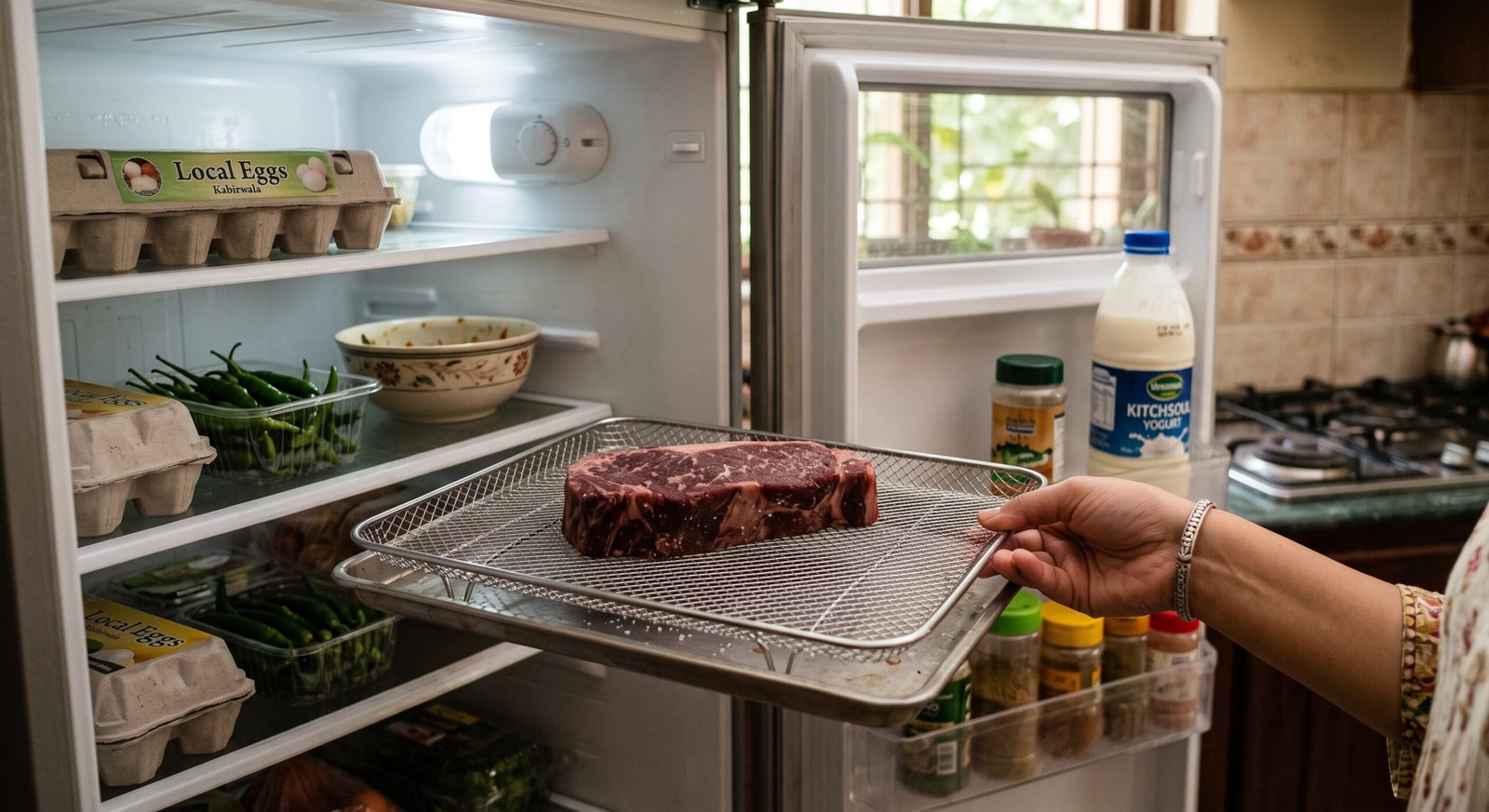
- Salt Early (Dry Brine): Generously salt all sides of a thick-cut steak (at least 1.5 inches thick) with kosher salt. Place it on a wire cooling rack set inside a rimmed baking sheet.
- Refrigerate Uncovered: Leave the steak in the fridge for 12 to 24 hours. The cold, dry air evaporates surface moisture, turning the outer layer a deep, translucent red.
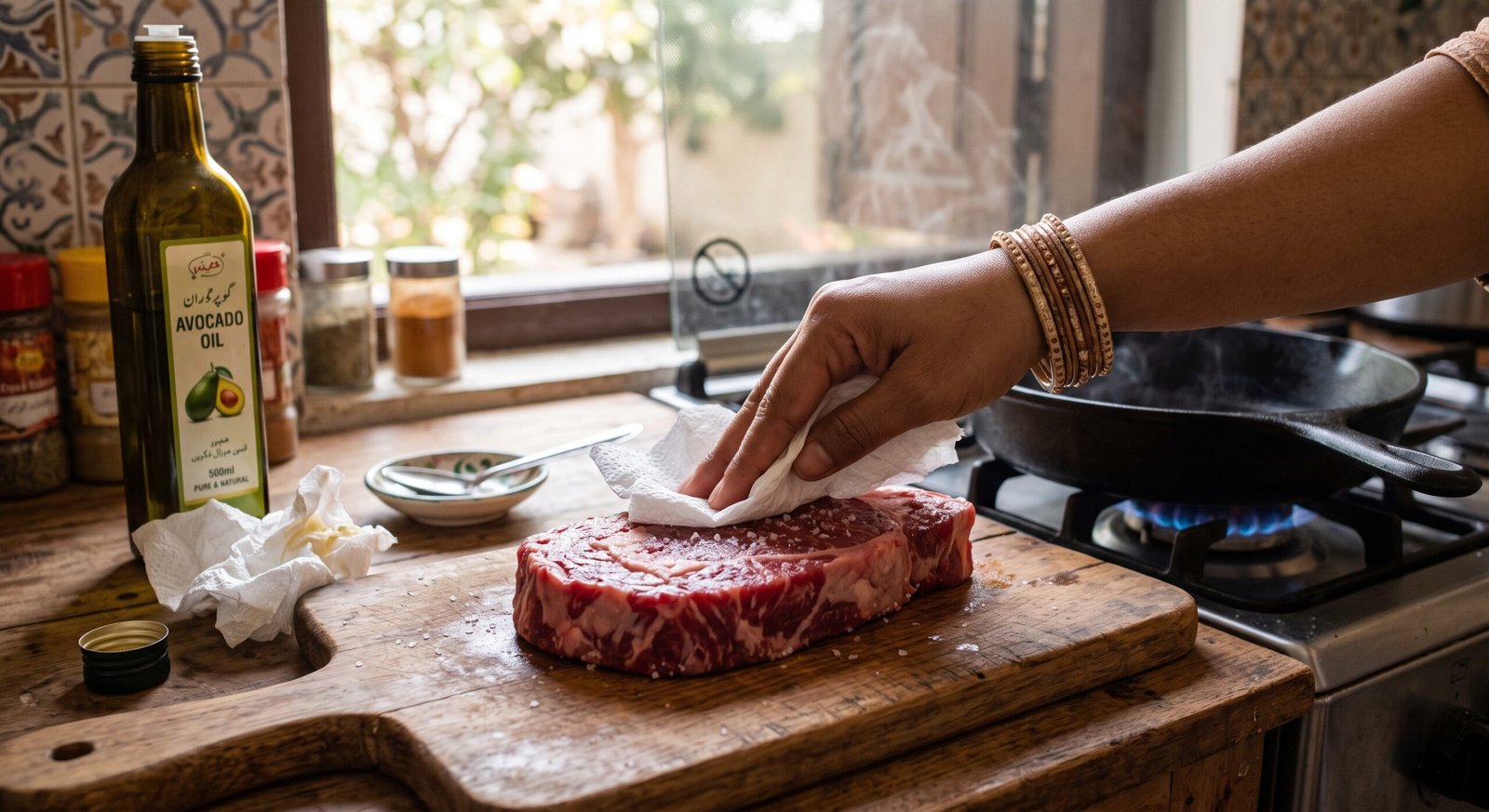
- Pat Dry: Right before cooking, pat the meat down thoroughly with paper towels.
Step 2: Choosing the Right Cookware & Fat
Not all pans are created equal when it comes to high-heat searing.
Cookware
Avoid non-stick pans; they cannot safely withstand the required heat and lose temperature instantly when cold meat is added. Opt for a preheated cast-iron skillet or heavy-gauge carbon steel pan. These materials hold onto heat, preventing temperature drops when the meat enters the pan.
High Smoke-Point Oils
Do not use extra virgin olive oil or whole butter to start the sear—they burn and turn bitter at high temperatures. Use high smoke-point neutral oils such as:
- Avocado Oil ($520^\circ\text{F}$ / $270^\circ\text{C}$)
- Ghee or Clarified Butter ($485^\circ\text{F}$ / $250^\circ\text{C}$)
- Beef Tallow ($400^\circ\text{F}$ / $205^\circ\text{C}$)
Step 3: Executing the Sear & Butter Baste
Follow this step-by-step technique for a perfect crust without gray bands:
1. Preheating
Heat your cast-iron pan over medium-high heat for 5 to 7 minutes until it is lightly smoking. Add 1 tablespoon of your high-heat oil.
2. The Initial Sear & Frequent Flips
Lay the steak into the pan away from you to prevent oil splashes. Flip the steak every 30 to 45 seconds. Frequent flipping cooks the interior more evenly while keeping the surface dry and hot for rapid browning.
3. Butter Basting (Arrosé)
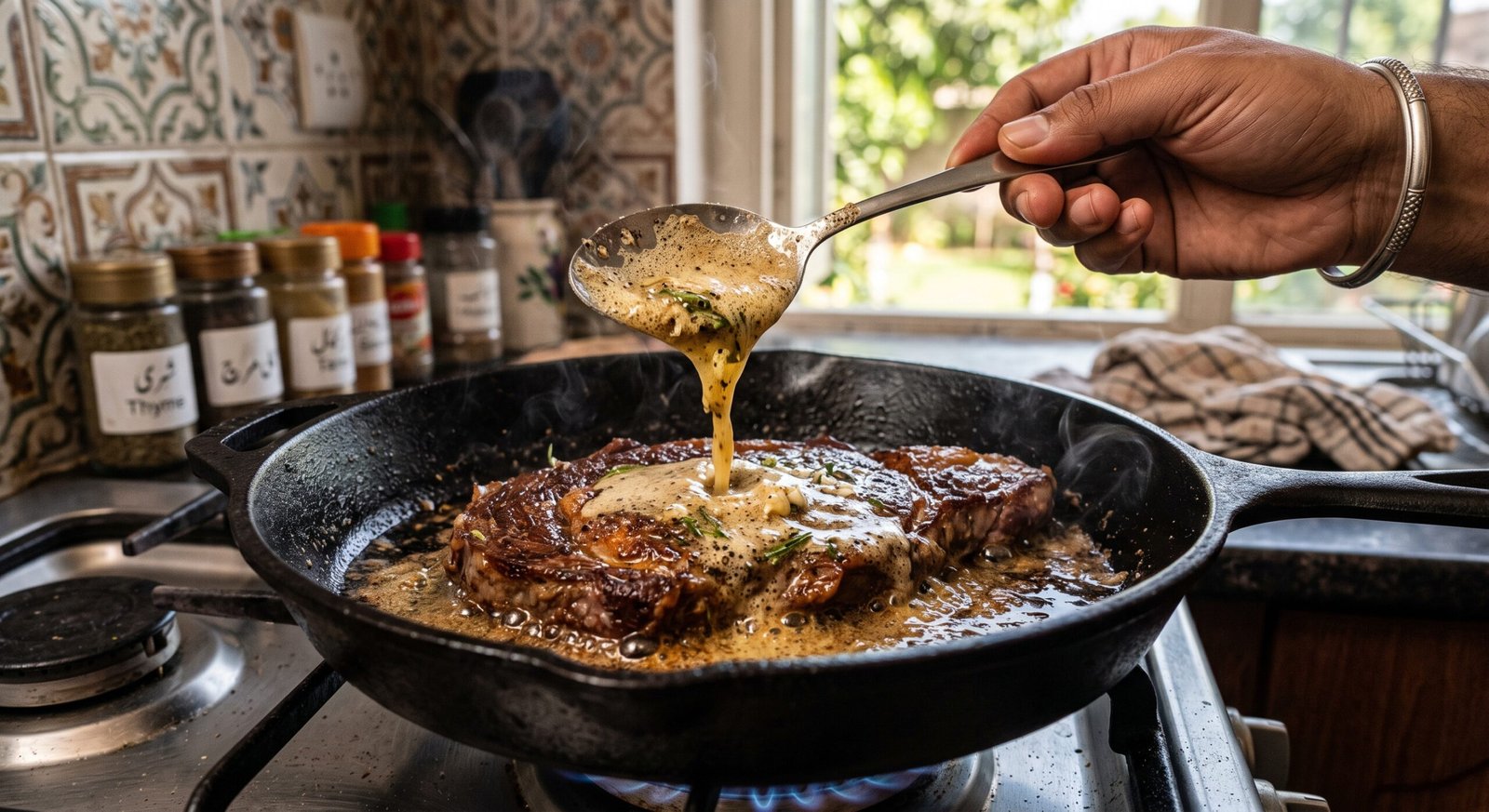
When the steak is within $10^\circ\text{F}$ to $15^\circ\text{F}$ of your target internal temperature, drop the heat to medium-low. Add 2 to 3 tablespoons of unsalted butter, crushed garlic cloves, and fresh thyme or rosemary. Tilt the pan and use a large spoon to rapidly baste the hot, foamy butter over the top of the steak for 1 to 2 minutes.
Conclusion
Developing a restaurant quality crust on steak at home isn’t reserved for professional chefs. By dry brining to eliminate surface moisture, using heavy cast iron to retain high heat, flipping frequently, and finishing with a flavorful butter baste, you can create a perfectly charred, tender steak every single time.
Frequently Asked Questions
Why is my steak gray instead of brown when I sear it?
A gray steak is caused by excess surface moisture or a pan that isn’t hot enough. When moisture turns to steam, it boils the surface instead of searing it. Always dry brine or pat your steak thoroughly dry with paper towels before placing it in a preheated, smoking-hot skillet.
Should I let steak come to room temperature before searing?
While common advice suggests resting meat on the counter for 30 minutes, scientific testing shows it makes very little difference to internal temperature. Focus instead on ensuring the exterior is completely dry before searing.
Does flipping a steak frequently ruin the crust?
No, flipping every 30 to 45 seconds actually creates a better crust and cooks the interior more evenly. It prevents heat from driving too deep into one side at a time, minimizing the gray band of overcooked meat underneath the crust
One Comment